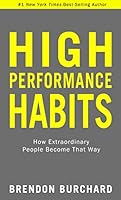
# High Performance Habits
**Brendon Burchard**
---
_High performance isn't about talent or personality. It's about making excellence feel mandatory._
Burchard's research is sprawling, covering six habits across hundreds of pages, but the idea that cuts deepest is necessity. Necessity is the emotional drive that makes great performance a must instead of a preference. Motivation fades, discipline depends on willpower, but necessity operates at a different level: the feeling that you absolutely must perform well, that failing to do so would violate who you are. When high performers describe what separates them, they consistently point to this internal pressure rather than to external reward.
The mechanism has two parts. The first is personal: high performers tie their identity to growth and contribution rather than to comfort or status. When your self-concept is "I am someone who does this work at this level," falling short creates internal dissonance that's harder to ignore than any incentive. This is [[Psycho-Logic|the identity constraint]] working in your favour. The constraint normally keeps people stuck, preventing change because it threatens who they believe they are. But when you build your identity around the practice itself, the constraint becomes a ratchet. Each day of showing up makes the next day of showing up more natural.
---
**The second part is social, and more deliberate than it sounds.** High performers don't keep their goals or the reasons behind them secret. They affirm them publicly, to the people around them. This creates social consequence. If you tell someone you're pursuing something and explain why it matters, your ego is on the line. You've created a situation where you need to honour your word, and that external accountability reinforces the internal necessity.
This isn't vision-boarding. It's structural. By verbalising a commitment, you make it more real to yourself and harder to abandon quietly. The accountability isn't someone else tracking your progress; it's the gap between what you declared and what you're doing. That gap creates productive discomfort, the kind that generates effort rather than anxiety. Burchard's observation: "I didn't need them to affirm me; I needed to affirm myself publicly so I could create a situation where I needed to honour my word."
---
**The most counterintuitive finding is about feelings.** High performers don't wait for the right emotional state before performing. They generate the feelings they want rather than accepting whatever emotions show up. Before entering any performance situation, they contemplate how they want to feel regardless of what arises, and they envision how they want to feel leaving. The emotions still come, but they aren't running the show.
This is a practical skill. It means asking, before a meeting or a difficult conversation: what kind of person do I want to be while I'm doing this? The question sounds soft. The discipline required to answer it and then act on it, repeatedly, under pressure, is anything but. Satisfaction doesn't cause great performance; it results from it. When you do what aligns with your future identity, you work harder and more effectively, which creates the satisfaction that sustains the cycle. The struggle, the discomfort, the daily confrontation with your own limits: these aren't obstacles to high performance. They're the practice of it. No one who achieved greatness avoided that confrontation. They met it, engaged with it, and knew it was necessary because real challenge pushed them beyond where comfort would ever take them.
---
**Monitoring closes the loop.** People who set goals and regularly self-monitor are almost two and a half times more likely to attain them. If you're not going to track your progress, you may as well not set the goal. High performers check in with themselves several times a day, not to judge but to recalibrate. They want to talk about how to improve, because their identity and enjoyment are tied to growth rather than to being right. The willingness to face faults and address weaknesses, rather than performing [[Confidence]], is what makes the necessity sustainable rather than brittle.
---