# Good Stocks Cheap
**Kenneth Jeffrey Marshall**
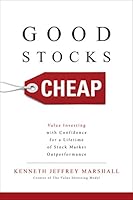
---
_Treat investing like a trade: sequential questions, no mysticism, just method._
Marshall presents value investing the way a plumber presents plumbing. Useful only if it works. The model has three questions asked in strict order: Do I understand it? Is it good? Is it inexpensive? Each must be answered yes before moving to the next. If you can't understand it, there's no point checking if it's good. If it's not good, there's no point checking if it's cheap.
That sequencing is the heart of the book. Price doesn't determine what to buy. It only determines when. You identify quality first, through operating performance, strategic positioning, and shareholder-friendliness. Price comes last.
---
**Understanding a business means describing it in a single, unambiguous sentence.** Six parameters define it: what products (commodity or differentiated?), who the customers are (consumers or organisations?), what industry, what form (public, private, subsidiary?), where operations and customers sit, and any status detail worth noting. People routinely mistake understanding one parameter for understanding all six, usually overweighting products. If the product makes sense, the whole business gets assumed to make sense. It doesn't.
The understanding statement focuses on what a business is, not what it could be. Resist the urge to complicate.
---
**Seven metrics cover the historical performance question.** Return on capital employed and its cash-flow equivalent measure how efficiently capital is deployed. Four more track growth in operating income, free cash flow, book value, and tangible book value per share. Liabilities-to-equity rounds it out as a measure of financial risk. These are the [[Ratios]] that make numbers meaningful; without them, absolute figures tell you almost nothing about whether a business is genuinely earning its keep.
Marshall prefers multiyear averages for normalising rather than adjusting individual years. The logic for not tweaking "one-time" items is sound: only future periods can determine what's truly irregular, management-level knowledge is required to identify them, and every year has irregularities. Once you start, there's no end.
---
**Most businesses don't have a moat, and accepting this saves time.** When one does, it usually has a single identified source: a government-granted privilege, a structural cost advantage, a brand with genuine pricing power, a network effect, [[Switching costs]], or ingrainedness (so integral to a value chain it's hard to picture the industry without it). The checklist for moat assessment isn't a shopping list of desirable attributes. It's a haunting remembrance of mistakes. It should reflect your own experience and previous errors, not a generic framework.
The valuation thresholds Marshall uses are simple qualifiers, not targets. MCAP/FCF no higher than 8. EV/OI no higher than 7. MCAP/BV and MCAP/TBV no higher than 3. When these are met, it usually means unjustifiably high discount rates are on offer. Buying inexpensively both increases return and lowers risk simultaneously, which inverts the standard finance claim that higher returns require higher risk. The gap between price and value is where returns live. "I prefer to assume the worst with the prospect of delight than to assume the best with the likelihood of disappointment."
---