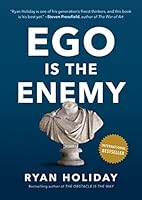
# Ego Is the Enemy
**Ryan Holiday**
---
_Choose doing over being, and choose it again every time the two diverge._
John Boyd's question, relayed by Holiday, cuts to the book's core: to be somebody, or to do something? Ego makes you choose being. It makes you chase recognition over results, defend your self-image instead of learning, and become fragile in the face of setbacks because failure threatens your identity rather than just informing your strategy. Holiday frames ego as "an unhealthy belief in our own importance" and shows that this belief is corrosive at every stage. When you're aspiring, it replaces work with talk. When you're succeeding, it makes you complacent. When you're failing, it makes you brittle.
---
**Passion is unreliable.** It's impulsive, self-centred, often a mask for weakness. Purpose is disciplined: outward-facing, enduring, bounded by reality. Purpose adds detail and timelines to values, chunking them into describable outcomes. Passion is breathless and frantic; it's a poor substitute for discipline, mastery, and perseverance. Failures are often as passionate as successes. Passion alone differentiates nothing.
The alternative Holiday proposes is detachment: acting without constant need for validation. Working without requiring immediate recognition. Absorbing criticism without defensiveness. Letting your work speak rather than your self-promotion. "Silence is the respite of the confident and the strong." If you need to tell people how important you are, you're not. Most successful people are people you've never heard of. They want it that way. It keeps them sober.
---
**Ego distorts reality and dulls the ability to learn, adapt, and build relationships.** Pride blunts the very instrument you need: your mind. A true student is like a sponge, absorbing, filtering, self-critical, self-motivated. There is no room for ego. When you're starting out, three realities are certain: you're not nearly as good or as important as you think you are; you have an attitude that needs readjusting; most of what you think you know is out of date or wrong. The temptation is to treat these as insults. The useful response is to treat them as information.
Ego also tempts you to substitute talk for action. Great work is draining, demoralising, and unglamorous, not always, but it can feel that way when you're deep in it. Output, tangible and measurable, is the test. Execution matters more than intention. The distinction between a professional and a dilettante occurs when you accept that having an idea is not enough: you must work until you can recreate your experience effectively in reality.
---
**Progress is obstructed by slights, dismissals, and rejection.** Ego says: I am better than this, I deserve more. The right response is clarity, determination, and composure, not indignation. "Those who have subdued their ego understand that it doesn't degrade you when others treat you poorly; it degrades them." Almost always, your road to victory goes through failure. Ego makes you brittle when that happens; failure threatens your identity rather than informing your strategy. This is [[Psycho-Logic|the identity constraint]] at its most personal. Humility makes you antifragile: failure becomes data.
The book's most persistent implication is about where your attention goes. Ego loves rumination: it lets you feel important without producing anything. A person who thinks all the time has nothing to think about except thoughts, so they lose touch with reality and live in a world of illusions. Reflection without action is just noise. And [[Psycho-Logic]] runs in reverse here: ego wasn't built on rational foundations, so rational arguments won't dislodge it. Only choosing differently, repeatedly, does.
---